










Wired vs Wireless Bras: A Simple Guide for Growing Girls

The first bra rarely arrives with a manual. A tween wants something comfortable under a favorite shirt, a parent wants coverage that fits real life, and everyone wants the moment to feel normal rather than awkward.
Choosing between a wired and a wireless bra is usually the first fork in the road. This guide explains the difference in plain language and offers a quick try-on checklist, all aimed at matching bra structure to a growing body and the way a day actually unfolds.
1. What Wired and Wireless Bras Actually Mean
Two bras can look nearly identical on a hanger, yet one hides a curved wire along the bottom of each cup and the other does not. That single detail is the whole distinction. A wired bra, or underwire, has a thin, curved wire sewn into the edge of the cup to add structure and lift. A wireless bra skips the wire and builds support from the band, the fabric, the seams and panels, and the overall shape of the design.
For a growing girl, it helps to know the three parts doing most of the work. The band carries most of the job, and it should feel snug and secure, never pinching or leaving marks. The cups handle coverage and shape, sitting smoothly with no gaping at the edges and no digging in. The straps only fine-tune the fit. They keep everything in place but are never the main source of support, so a girl constantly hiking them up usually has a band that is too loose.
A few gentle myths deserve clearing up. A wire that pokes or aches signals the wrong fit rather than proof that all wires are uncomfortable. Wireless does not mean unsupported either, since a good band and lining can hold plenty. A good fit feels stable during movement, with no pinching, no scratchy seams or tags, and no need to keep adjusting. When a bra disappears from a girl's attention, that is the target.
2. When a Wired Bra Makes Sense, and When to Skip It
A wired bra earns its keep in a narrow set of situations. Under a fitted top, the wire creates a more defined, sculpted shape and holds it in place. For certain outfits, that lift and separation is exactly the look som6eone is after, which makes the wire a specialty tool rather than an everyday default.
The trade-offs matter more for a growing body. Wires are the classic culprit behind poking at the sides or center, rubbing raw through a long school day, and that stiff, boxed-in feeling that makes a girl count the minutes until she can take it off. Growth adds another wrinkle: a wire that sat perfectly last season can turn wrong within weeks, because the shape it was built around has already changed. The full underwire bras pros and cons are worth reading before committing.
For anyone curious enough to test one out, a few guardrails keep the experiment honest:
-
The wire lies flat against the ribcage and never presses into breast tissue.
-
No stabbing or pinching under the arm, and the band stays level all the way around.
-
A deep breath comes easily, with no squeezing or restriction.
If any of those fail, the wire is wrong for that body right now. A girl new to bras, one sensitive to pressure points, or anyone who simply wants something she can forget about from breakfast to bedtime is better served by a wireless design. All-day comfort tends to win far more often than a sculpted silhouette built for a single outfit.
3. Why Wireless Bras Fit Real Teen Life
Wireless does not mean flimsy, and this is where the reassurance matters most. A well-made wireless bra can hold plenty; it just gets that support from the band, lining, and shape rather than a piece of metal. Once that clicks, the reasons teens gravitate toward wireless make sense.
Comfort matters most. A wireless design suits the shape of a real day: seven hours in a classroom chair, a walk between buildings, the jostle of a bus ride, the slump into a couch after homework. There is no single perfect position to maintain and no pressure point that starts nagging by third period. For a body still changing month to month, that flexibility is a genuine relief, and it moves well whether a girl is dashing to catch a ride or lounging with a book.
Here is the piece parents often miss: wireless is a category, not one design. An unstructured bralette gives light, barely-there support and maximum softness. A structured wireless bra builds real shaping through fabric architecture, wider bands, and thicker linings. Both skip the wire, but they perform very differently, which is why comparing the best wireless bra for teen girls helps a family match structure to need.
Most wireless complaints trace back to fit rather than the category. "It flattens me" usually means too little shaping structure, a gap the next section addresses. "It rides up" points to a band that is too big. "The straps keep falling" signals a strap placement or adjustability issue. Sorting the comfortable wireless bras for teens by those criteria turns a vague frustration into a solvable checklist.
4. How to Judge Support in a Wireless Bra: 7 Features Worth Checking
The last section ended on a promise: "it flattens me" is a shaping problem, not a verdict on wireless bras as a whole. So what actually creates support and shape when no wire is doing the heavy lifting? The answer lives in a few construction details a hanger never reveals. A wired bra separates through structure, while a wireless bra achieves a similar effect through smart design, and knowing what to look for turns guesswork into a quick scan.
Seven features signal real support in a wireless design:
-
A wide underband. Support starts here, so a broader band spreads the work across the ribcage instead of loading it onto the straps.
-
Double-layer fabric or targeted panels. Two layers add stability and smooth coverage a single thin layer cannot.
-
Thoughtful seam placement. Well-positioned seams shape gently without scratching sensitive skin.
-
Light shaping at the center. A touch of definition keeps things separated rather than merged into one flat line.
-
Side support. A little structure at the sides keeps tissue from drifting outward during movement.
-
Adjustable straps. Fine-tuning should come from the straps rather than from cinching them painfully tight.
-
Padding that stays put. Sewn-in padding gives smooth coverage without the constant fixing that loose, removable pads invite.
A spec list only reveals so much. A thirty-second try-on at home confirms the rest: a quick jump in place to check nothing shifts or rides up, a reach overhead to see the band stays level, and a deep breath to confirm there is room to move without squeezing. Pass all three, and the support is doing its job.

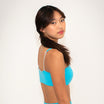
This is the thinking behind Bleuet's comfort-first design. The Bleum Bra is double-lined and reversible in 90% polyester with 10% spandex, and its fabric is STANDARD 100 by OEKO-TEX certified. At $24 in sizes 6 to 24, it is the widest-fitting style in the range, and the double lining is what gives smooth coverage without a wire anywhere in the build.
5. How to Match the Right Bra to a Real Day
Everything so far points to one practical question: which bra, for which day? The honest answer is that many growing girls do best with more than one style, matched to what the day actually asks.
Wireless earns the everyday slot in a few clear cases: when all-day school comfort is the priority, when a girl is in a growth spurt or landing between sizes, and when pressure points, scratchy seams, or tags are dealbreakers. Reach for a wired style only in a narrower band of situations, when a specific outfit calls for structured shaping and a girl already feels at home in structured designs with a spot-on fit.
Activity is the next filter. A low-movement day of classes and homework asks far less than an afternoon of dance or sports, which is why many families keep an everyday bra and a movement bra in rotation.

For high-energy days built around athletics, the Bleum Active Bra is the style Bleuet builds for movement. It uses soft, moisture-wicking performance fabric that fits seamlessly under a shirt, jersey, or tank, with minimal seams and a tag-free finish. It is 90% polyester with 10% spandex, $24, in sizes 7/8 to 22.
A few comfort guardrails hold across every style. Any bra that causes real pain, leaves redness that lingers well after it comes off, or needs constant adjusting is a no. For a girl with rib or chest-wall tenderness, soft bands and flexible designs deserve first pick.
Longevity is the detail most guides skip. A wired bra tends to wear first at the wire channels, where the casing frays or the wire works loose. A wireless bra shows its age through band stretch and tired elastic. Either way, a few small habits extend the life of both: use a wash bag, run a gentle cycle, and let bras air dry rather than tumbling them in heat.
6. Why Bleuet Bras Are Built for the In-Between Years
There is a stretch of childhood that most brands ignore: too old for a plain undershirt, too young for anything modeled on a women's range. Bleuet was designed for exactly that gap, making foundational wear that fits a growing girl's body and her sense of self at the same time.
The design choices trace directly back to those pain points. Every everyday style is wire-free, so there is no metal to poke a rib or wear raw by lunch. Seams are kept minimal, and the everyday styles are finished tag-free and pinch-free, which removes a common source of scratching. Adjustable straps and stretch fabrics let one bra keep fitting across a season rather than a single month. Coverage comes from the construction itself, through double lining or sewn-in pads, rather than from loose inserts that slip out in the wash.

Matching a style to a need stays simple. For a first bra or reliable everyday layer, the reversible, double-lined Bleum Bra is a good place to start. For more coverage, the Bleum Petal Padded Bra has its pads sewn permanently inside, so nothing shifts or needs refitting. For a smooth line under a fitted tee, the Nara T-Shirt Bra is wire-free with sewn-in cups and a V neckline, at $32 in sizes 12 to 22.
Sizing follows simple T-shirt sizing rather than a band-and-cup measurement, with adjustable straps to fine-tune the fit. Across the range that means sizes 6 to 24 depending on style, so a girl picks the size she already wears in a top. Straightforward returns take the pressure off getting it perfect on the first try.
7. Where to Start When You Are Ready to Shop
Reaching the end of a comparison guide can leave a parent staring at a long list of features with no clear first move. The good news is that the first step is small and easy to reverse: comfort comes first, and structure only enters the picture if a growing girl actually needs it.
To begin, browse the softest everyday bras collection, which gathers the wire-free, tag-free styles built for ordinary school days. For families who would rather skip straight to a proven starting point, the Bleum Petal Padded Bra offers soft coverage with pads sewn permanently in place. Prefer to look around first? The Bleuet homepage lays everything out in one spot. Begin with wireless for everyday comfort, then add structure only if it is truly needed.
Frequently Asked Questions
Is underwire bad for you?
Not automatically. An underwire that pokes, rubs, or aches signals a poor fit or a style mismatch, not a health hazard. If a wire presses into breast tissue or leaves lingering redness, that bra is wrong for a growing body right now. Many families skip wires entirely during the growth years simply because a wireless design stays comfortable through changing shapes.
Can wireless bras be supportive?
Yes. Support comes mainly from the band and smart construction, not from metal. A wide underband, double-layer fabric or targeted panels, and adjustable straps do the real work. A well-made wireless bra holds plenty while staying soft, which is why so many tweens and teens wear one every day without a second thought.
Do I need a bra to prevent sagging?
No. For tweens and teens, the priority is comfort and support that matches daily activities, not preventing anything. There is no rule that requires a specific bra. The right choice is whatever feels good, moves well, and gives a girl confidence under her favorite clothes, whether that is a soft everyday style or a sturdier one for sports.
How do I know if a bra fits?
A good fit stays quiet all day. The band sits level and snug without pinching, deep breaths come easily, cups lie smooth with no gaping, and there is no constant tugging or adjusting. If a girl lands between sizes, prioritize comfort and adjustability over an exact number.
Can I sleep in a bra?
If a girl wants to, a very soft, wireless style that never feels tight is the way to go. Sleep is optional, not required. Anything that squeezes, digs, or feels restrictive should come off at night, since rest matters more than coverage in bed.
Leave a comment